In the landscape of modern baking, we often witness a technological paradox. On one hand, we have numerically controlled ovens and precision proofing chambers; on the other, an approach to raw materials based on empirical habits and marketing myths persists.
The majority of failures in modern pizza from structural collapse to rubbery “chewing gum” texture do not stem from procedural errors. They stem from a fundamental misunderstanding of flour rheology.
This article is not a collection of recipes. It is a technical analysis designed for those who intend to understand the biochemistry of dough in order to stop replicating and start designing.
1. The Paradigm Shift: Flour as a Stochastic Variable
The ontological error committed by most operators is treating flour as a passive ingredient, much like salt or oil. A passive ingredient is a constant: 50 grams of salt will always have the same salting power.
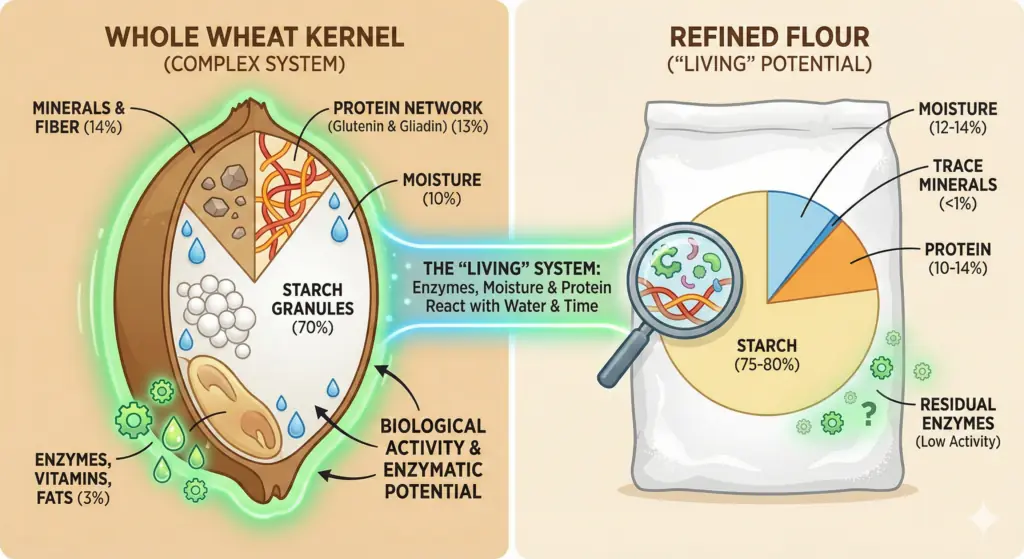
Flour, conversely, is a system variable. It is a complex biological matrix that defines the physical and chemical constraints within which your entire recipe must operate.
It dictates:
- Real Absorption Capacity (distinct from theoretical hydration).
- Fermentation Kinetics.
- Thermodynamic Response during baking.
When a recipe fails, it is rarely because the measurements are wrong. It fails because you attempted to force a variable (e.g., a 48-hour fermentation) beyond the tolerance limits imposed by the specific flour matrix you used.
2. Deconstructing Marketing: Why “Type” and “Protein %” Lie
To operate at a professional level, it is necessary to abandon commercial nomenclature.
The Fallacy of the “Type”
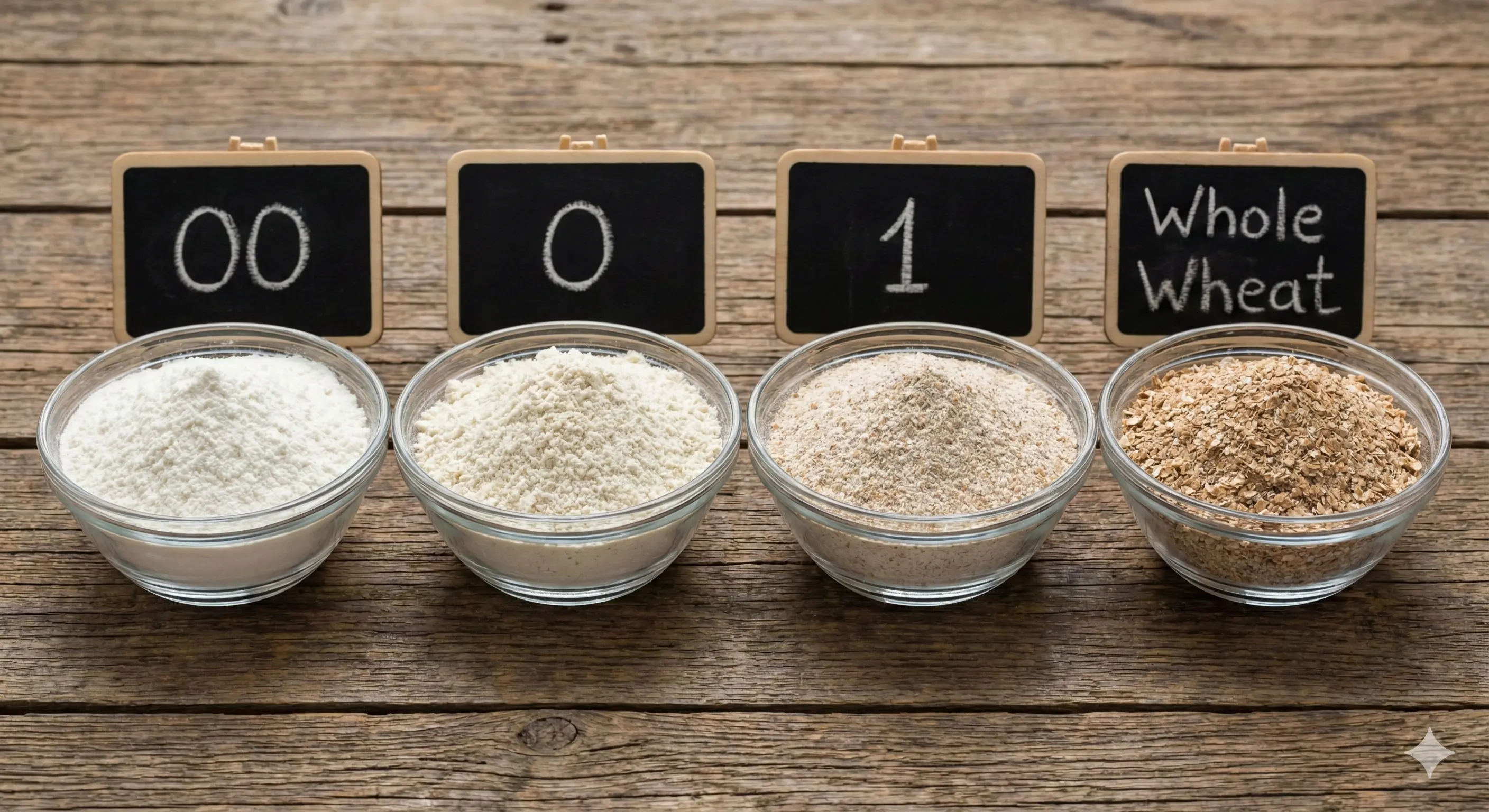
Labels like Italian “Type 00,” “0,” “1,” or “Whole Wheat” refer exclusively to the Ash Content (mineral residue after combustion) and the extraction rate. While ash influences fermentative activity (acting as nutrients for yeast), the “Type” offers zero indication regarding the rheology of the dough.
Two flours classified as “00” can exhibit opposite behaviors: one might be suitable only for biscuits, the other for Panettone.
The Myth of Protein Percentage
The most misleading figure of all is the protein percentage printed on the nutrition label.
In food chemistry, quantity does not equal functionality. A flour can boast 14% protein yet generate a gluten network with an unbalanced Stability Index (P/L), capable of neither extension nor gas retention.
- Low-Quality Gluten: Aggregates but lacks elasticity, tearing under gas pressure.
- High-Quality Gluten: Creates a viscoelastic network capable of expanding without rupturing.
Relying solely on protein quantity is akin to judging a car’s performance only by the size of its fuel tank, ignoring the horsepower of the engine.
3. The Four Structural Pillars of Flour
To evaluate flour with an analytical eye, we must examine four interconnected parameters that determine the “operating window” of your dough system.
A. Protein Quality and Viscoelastic Balance
It is not enough for gluten to form; it must possess the correct balance between Tenacity (P, resistance to deformation) and Extensibility (L, ability to stretch).
Proteins (Gliadins and Glutenins) must be tenacious enough to structure the product, yet extensible enough to allow volume increase. If quality is poor, proteins will degrade prematurely under the action of acids produced during fermentation, leading to alveolar collapse.
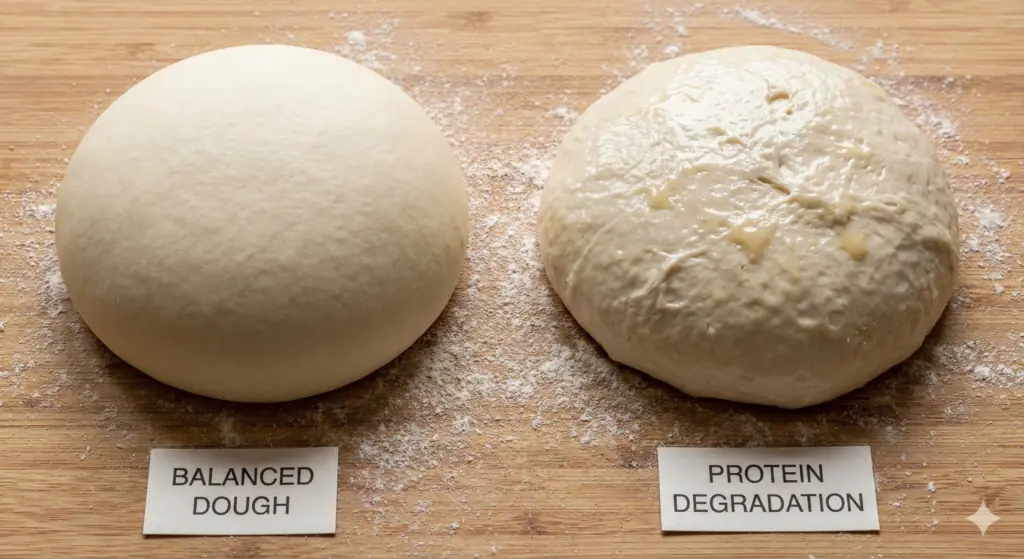
Caption: Visual effects of protein degradation on an over-matured dough.
B. Enzymatic Kinetics (Falling Number)
Flour is biologically active. Alpha-amylases are enzymes that degrade damaged starch into simple sugars, feeding yeast and fueling the Maillard reaction.
Enzymatic activity is measured by the Falling Number (Hagberg Index):
- Excessive Activity (Low FN): Leads to sticky doughs that are difficult to handle and brown too quickly in the oven (risk of external burning with a raw interior).
- Insufficient Activity (High FN): Inhibits fermentation, resulting in pale, compact products with poor development.
C. Starch Damage
During milling, starch granules suffer physical damage. A controlled level of damaged starch is desirable as it absorbs more water than intact starch and facilitates enzymatic attack.
However, excessive damage (common in aggressive industrial milling) creates “False Absorption”: water is absorbed initially but released during baking when the protein structure coagulates. The result is a gummy, wet crumb, regardless of baking time.
D. The Catalytic Role of Ash
Minerals do not impact flavor alone; they act as metabolic accelerators for yeast and influence the Buffer Capacity of the dough.
Less refined flours (Type 1, Whole Wheat) ferment with significantly faster kinetics compared to a highly refined ’00’. Applying the protocols of a ’00’ flour to a Type 1 will almost inevitably lead to over-proofing.
4. Hydrodynamics: Beyond Hydration Percentage
Water is the reagent that activates the system. Discussing hydration (60%, 70%, 80%) without contextualizing the absorption capacity of the flour is a useless theoretical exercise.
True absorption is not how much water you put in the mixer, but how much water the structure can chemically bind.
Free water (unbound) is the enemy of structure: it creates uncontrolled steam that destroys the alveoli and weighs down the product. The true skill lies in balancing hydration with the hygroscopic capacity of the proteins and damaged starch.
[INSERT IMAGE: Macro shot of the crumb (alveoli) of a successful high-hydration pizza vs. a collapsed one]
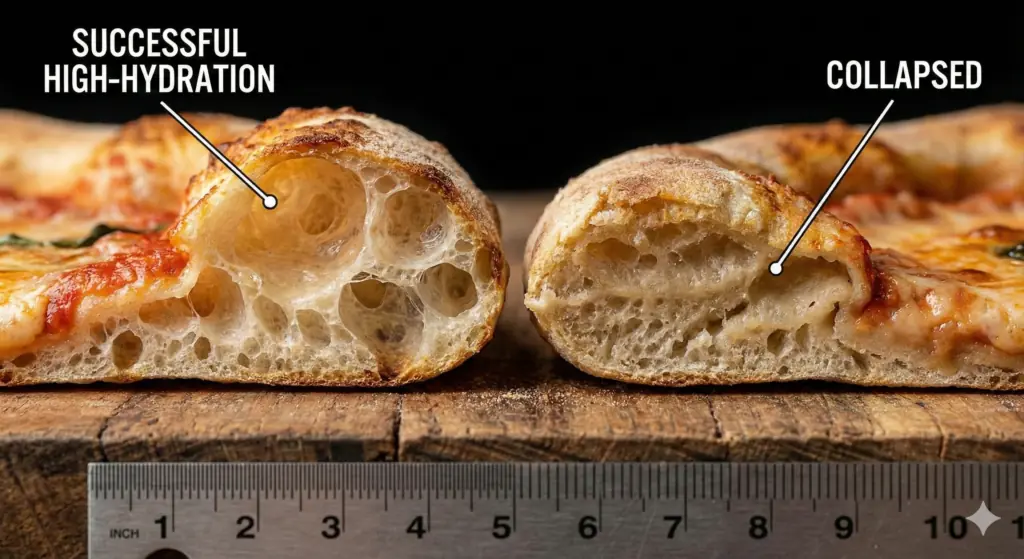
Caption: Left: Water was retained by the structure until gelatinization. Right: Free water caused a structural collapse.
5. The Myth of Strength (W) and Thermal Interaction
There is a dogmatic tendency to consider “Strength” (W) as an index of absolute quality. This is a technical error. Strength is a measure of resistance to load.
Using a high-W flour (e.g., Manitoba, W 400) for short fermentation processes (6-8 hours) generates a dough that does not have the physical time to relax the gluten network. The result is the so-called “rubberiness” (chewing gum effect) and poor melt-in-the-mouth quality.
The golden rule is: Use the flour with the minimum strength necessary to support the chosen process, not the one with the maximum strength available.
Reverse Engineering from the Oven
Flour selection must start from the end: the oven.
- Neapolitan Oven (450°C+ / 850°F+): Requires flours that do not caramelize instantly (low residual amylase activity) and possess a starch structure capable of “Flash Gelatinization.”
- Electric/Deck Oven (250-300°C / 500-600°F): Requires flours with higher enzymatic support (or added malt) to guarantee correct browning during longer baking times.
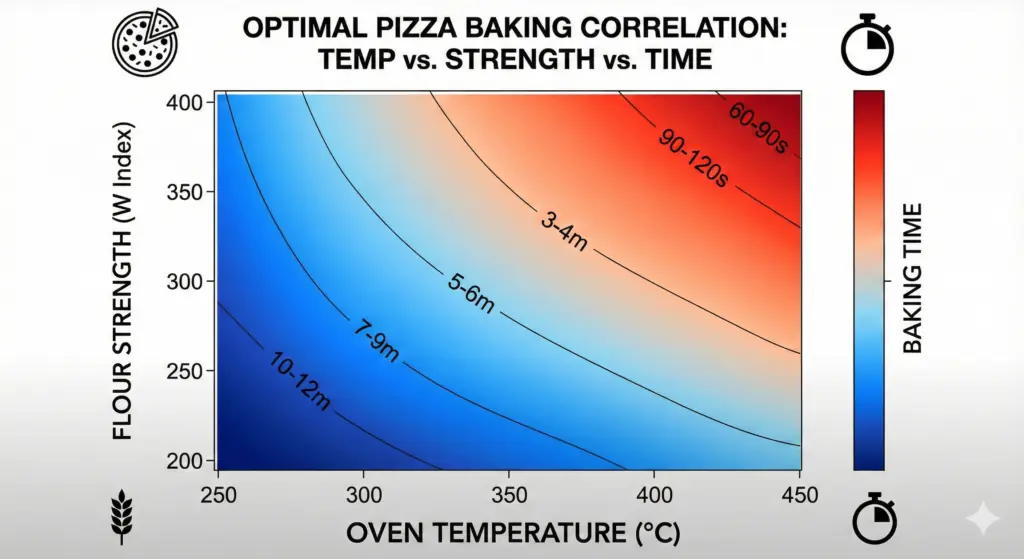
Caption: How oven thermodynamics dictates raw material selection.
6. Conclusion: Design, Don’t Execute
Stopping the search for the “best flour” is the first step toward technical maturity. There is only the correct flour for the specific protocol of time, temperature, and hydration you intend to apply.
Visual defects in the finished product irregular spotting, flat cornicione, burnt bottom, or dense crumb are almost always the delayed manifestation of a misalignment between the rheological characteristics of the flour and the thermal energy applied.
The true artisan does not apply recipes: they analyze the properties of the raw material and adapt the process to navigate within the tolerance limits imposed by the biology of the wheat. Everything else is improvisation.
Quick Technical Glossary
- P/L Ratio: The relationship between Tenacity (P) and Extensibility (L). Ideal values for round pizza: 0.50 – 0.70.
- W (Alveograph): The deformation energy index (Strength).
- Falling Number: Falling time in seconds. Ideal values for bread/pizza: 250-300s.
- Gelatinization: The process where starch absorbs water and solidifies with heat (occurring between 60°C and 80°C).
Did you find this technical deep-dive useful? Subscribe to the newsletter to receive detailed analyses on fermentation curves and temperature management.